RUNE - a Souls-Like Solo RPG
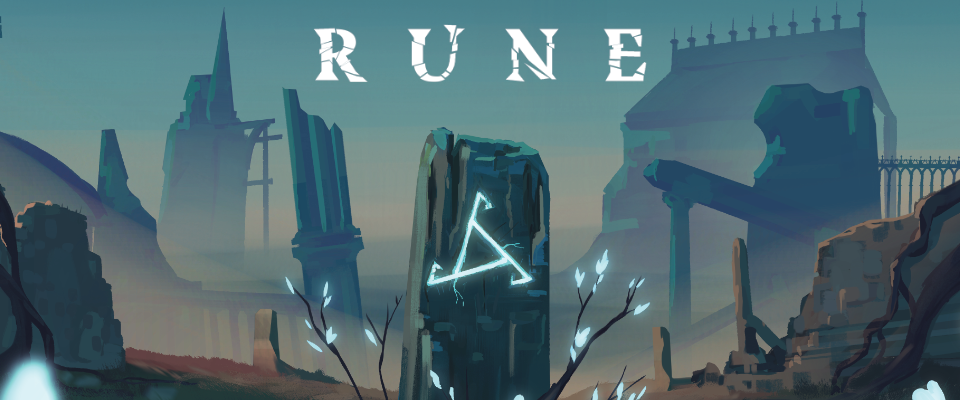 |
| My first independent tabletop RPG, bought through itch.io |
What kind of RPG is RUNE?
-
Complexity: Low-Med
-
Theme: Dark fantasy, Dark Souls inspired
-
Core mechanic: Stamina dice assigned to actions
-
Character model: Gear-driven character build
-
Combat: Tactical grid puzzle combat
-
Gameplay focus: Solo tactical encounters and exploration
My play experience
One of the things I immediately appreciated about RUNE is how quickly it gets to the table. Compared to many tabletop RPGs, the setup is extremely light. Character creation is almost entirely driven by equipment, so instead of building a long list of abilities or writing a detailed backstory, you start by choosing the gear that defines how you fight.
That choice matters more than it first appears. A sword-and-shield build plays very differently from a character built around ranged attacks or magic and mobility. As you explore the realms of Obron, you can also discover new weapons, spells, and runes that expand what your character can do.
For my first run, I created a very simple concept to anchor the experience.
Eadwold the Engraved — Paragon of the Flame.
 |
His starting equipment looked like this:

One of the most interesting mechanics appears directly on the equipment cards. Each weapon or spell shows dice results that determine what actions are available when you roll your stamina dice. It’s a simple idea that drives the tactical decisions in combat.
Fighting in RUNE takes place on a small 4×4 grid, and each encounter feels more like solving a puzzle than executing a traditional RPG battle. Enemies telegraph their actions through dice rolls, giving you a brief moment to react. On your turn you roll your stamina pool and assign those dice to your available equipment, deciding whether to attack, reposition, or prepare for the enemy’s next move.
The result is surprisingly tense for such a compact system. Every turn feels like a small optimisation problem: how do you use the dice you have to survive the round and deal the most damage possible?
Between fights, the game shifts into exploration. Each realm is a short, self-contained level made up of connected locations. The game includes seven realms in total.
Here is the starter realm:
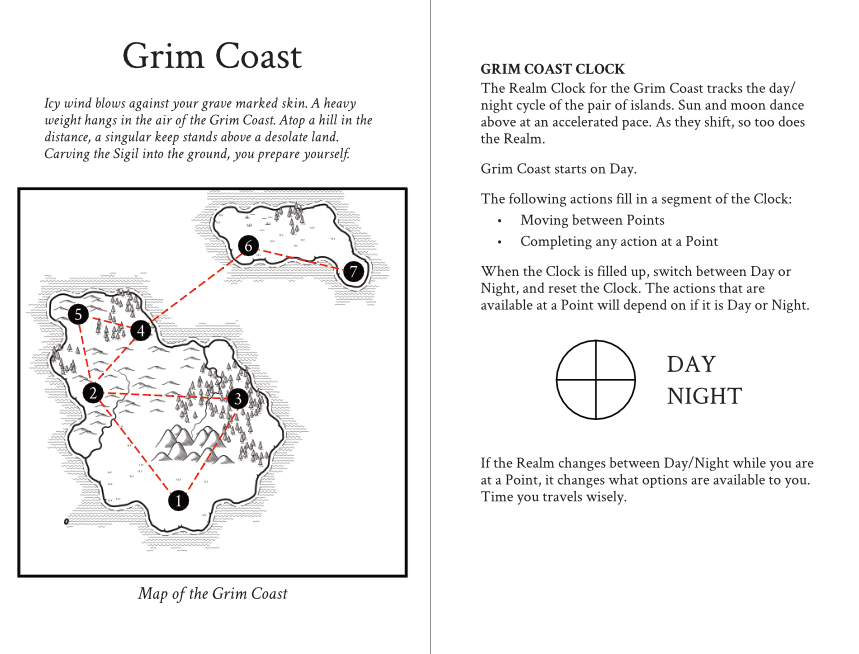 |
| Grim Coast, the starter Realm, includes a day night cycle that changes the state of each location |
Exploration itself is deliberately simple. Moving to a location allows you to choose between actions such as FIGHT, SEARCH, or DELVE, each described in the realm atlas. These actions might uncover useful items, reveal lore, or unlock new areas.
But every action also advances the realm clock.
As the clock progresses, the state of the realm changes. Enemies appear, locations evolve, and new complications can emerge. This creates a constant tension between caution and urgency. Do you explore every location to gather advantages, or push quickly toward the final confrontation before the world becomes even more dangerous?
Death, unsurprisingly for a Souls-inspired game, is part of the loop. When your character dies, you return to the starting location and most enemies respawn. That creates a familiar rhythm: explore, learn, adjust your equipment, and try again.
And in that sense, RUNE does capture something essential about the Soulslike experience. Progress isn’t only about winning. Sometimes it’s about learning just enough from failure to survive the next attempt.
What I liked
Simplicity and ease of setup
RUNE is extremely quick to learn and easy to return to for short solo sessions.
One of RUNE’s biggest strengths is how quickly it gets to the table. The rules are straightforward, and character creation is largely defined by your equipment rather than a long list of abilities or background choices.
After spending time with more complex systems like D&D 5E, this simplicity is refreshing. Exploration resolves quickly, and individual combats typically take around 10–15 minutes. Once you understand the structure of play, it becomes very easy to sit down and make meaningful progress in a 30-minute session.
For solo play especially, that low barrier to entry makes the game easy to return to again and again.
The tone
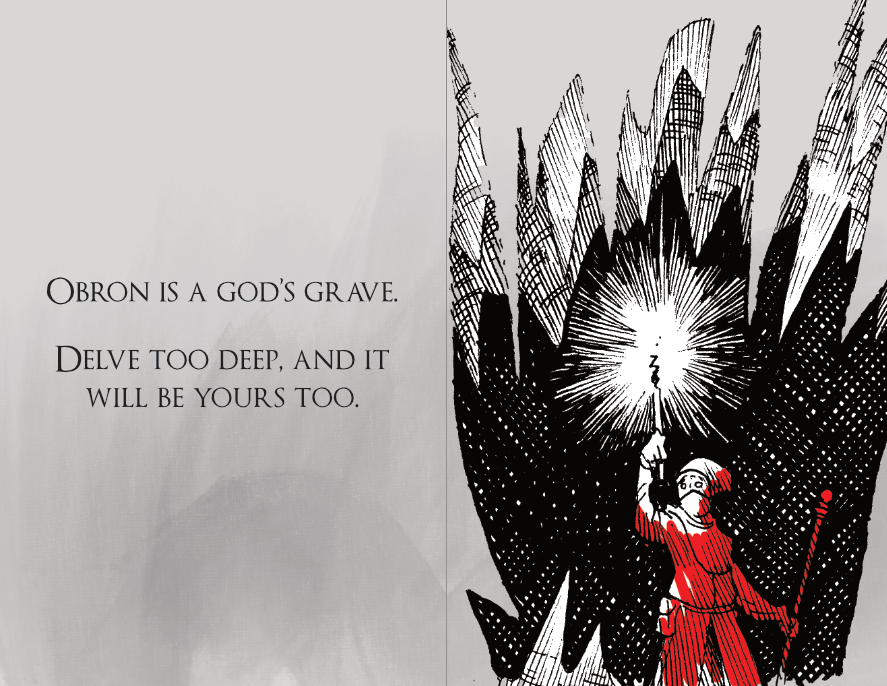
The sparse presentation creates a bleak atmosphere that captures the Soulslike inspiration.
 |
| Image by Gila RPGs |
Given my love for the games that inspired it, the bleak and mysterious tone of RUNE immediately resonated with me. The rulebook uses sparse but evocative imagery, and the fragments of narrative scattered throughout help establish the feeling of a lone wanderer travelling through a ruined world.
The game never overwhelms you with lore. Instead, it provides just enough atmosphere to frame the experience while leaving space for your own imagination to fill the gaps.
And if you happen to play while listening to the Dark Souls soundtrack, it certainly doesn’t hurt.
Puzzle-like combat
Encounters feel less like traditional RPG combat and more like solving a tactical puzzle.
Combat is where RUNE really shines.
Encounters take place on a compact 4×4 grid, and the combination of enemy behaviour, movement options, and stamina dice creates a series of interesting tactical decisions each turn. Rather than long sequences of attacks and damage rolls, each fight feels more like solving a small puzzle.
You are constantly weighing options: how to position yourself, which abilities to activate, and how to use the dice you rolled most effectively. The result feels like an unusual blend of Chess and D&D, where careful positioning and timing matter as much as raw power.
Replayability
The core loop encourages experimentation with gear, tactics, and repeated attempts.
RUNE is designed to be replayed, and that philosophy is built directly into the core gameplay loop: explore, fight, die, return stronger.
Death is not the end of the journey but part of the progression. When you fall, you return to the starting point and have the opportunity to adjust your equipment, change tactics, and attempt the realm again.
Because character builds are driven by gear and runes, even small changes in your loadout can create a noticeably different experience. The same realm can feel quite different depending on how you approach it.
And if the seven realms included in the game aren’t enough, the itch.io community has already created additional ones, extending the journey through the fractured world of Obron.
Concerns I had
Plays like a board game
The game focuses heavily on tactical decision-making rather than emergent storytelling.
To be clear, I enjoy board games very much, so this observation is not necessarily a negative for me personally.
However, compared to other solo tabletop RPGs, RUNE sometimes feels closer to a tactical board game experience. The focus is on movement, positioning, and mechanical decision-making rather than character interaction or narrative development.
Roleplaying can certainly exist if you choose to bring it into the experience, but the system itself does not strongly encourage it.
Complete knowledge
Most locations reveal their risks and rewards immediately, reducing the sense of discovery.
When you arrive at a location, you are presented with the available actions along with their associated risks and rewards. This allows you to make informed strategic decisions about whether it is worth advancing the realm clock in exchange for potential benefits.
In many ways this supports the tactical nature of the game, but it does reduce the sense of discovery. In the Dark Souls games that inspired RUNE, information itself is often the reward for taking a risk.
Once you have explored a realm fully, you effectively have perfect knowledge of its structure, leaving little uncertainty beyond the outcomes of combat.
What I would bring to other RPGs
Whenever I try a new system I ask what ideas I can bring back to my regular campaigns.
From RUNE I noted three mechanics that could easily inspire other games:
In summary
RUNE succeeds at delivering challenge and replayability, two of the defining qualities of the games that inspired it.
Where it differs is mystery. Because information is visible before decisions are made, the game leans more toward tactical optimisation than discovery.
Even so, I enjoyed my time with it.
If you are looking for:
-
a fast solo RPG
-
tactical puzzle combat
-
a grim Soulslike atmosphere
RUNE is an easy recommendation.
Especially if you only have 30 minutes to play.
And if you enjoy experimenting with RPG mechanics, it’s also a great system to mine for ideas.
Dashmeister
 |
| Image by Gila RPGs |


