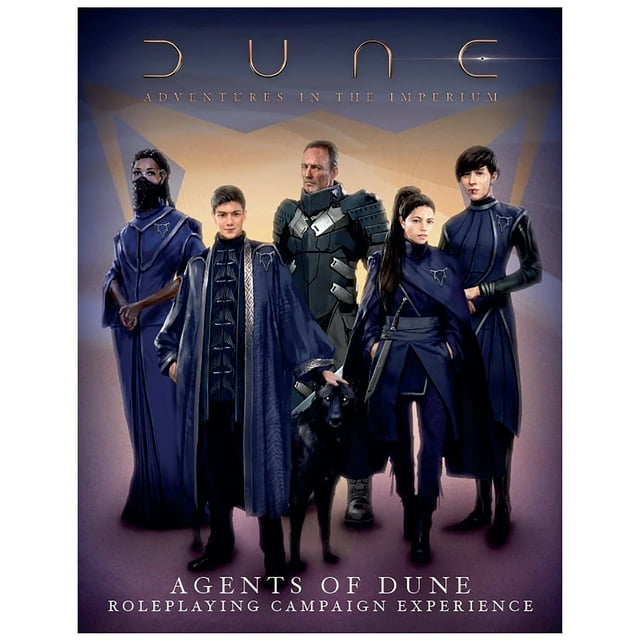
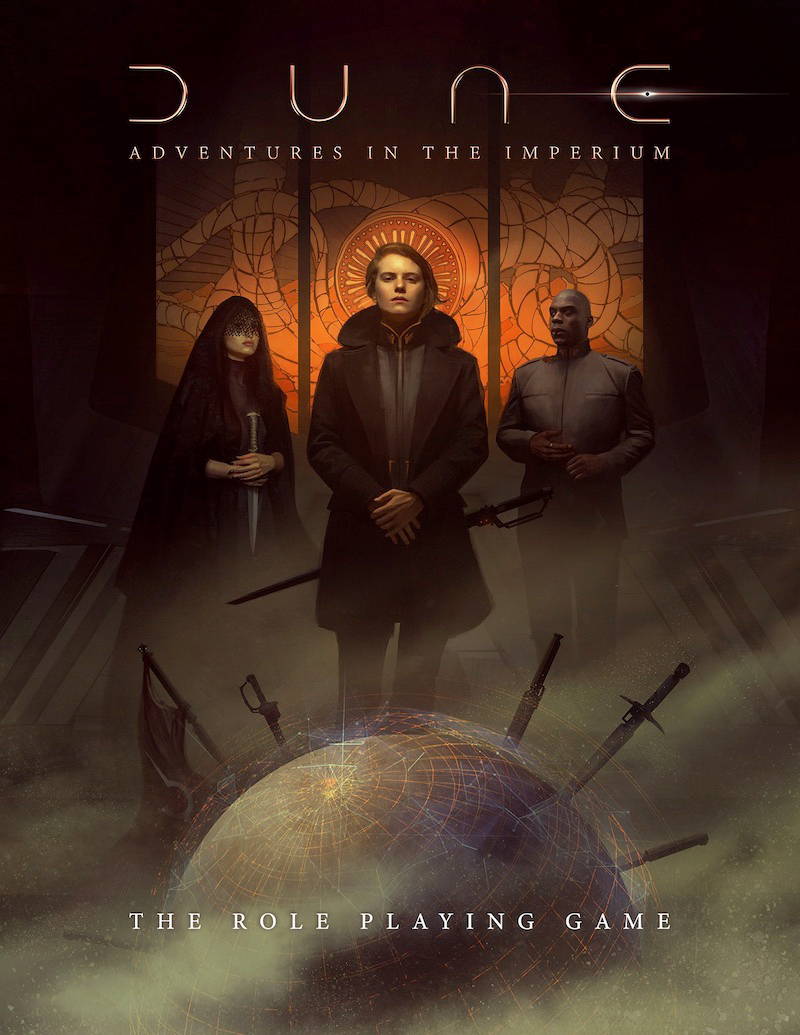
 |
| Image by Modiphius Entertainment |
[8 min read]
I went into Dune: Adventures in the Imperium expecting political intrigue, impossible decisions, and factional manipulation.
What I did not expect was how uncertain my group would feel about the rules.
Over eight four-hour sessions, our group of six played through a mini-campaign full of espionage, negotiation, divided loyalties, and increasingly dangerous political consequences. We had an excellent time.
I am also not convinced we ever fully understood the system.
But despite occasionally bouncing off the mechanics, the game still delivered something that genuinely felt like Dune: tense conversations, competing agendas, difficult compromises, and the constant sense that every decision could spiral into catastrophe.
If you are curious about Dune RPG but worried it looks mechanically intimidating, I do not think you need to master every subsystem to enjoy it. This article is less a review, and more a reflection on what actually mattered at our table, where we struggled, and what helped the campaign succeed anyway.
Who I Think This Game Is For
You will probably enjoy Dune RPG if:
- You love political intrigue more than tactical combat
- You enjoy collaborative problem-solving
- You like campaigns built around negotiation, influence, and consequences
- You already enjoy the Dune universe
You may bounce off it if:
- You want frequent combat encounters
- You enjoy highly structured tactical systems
- You prefer very clear mechanical procedures
- You love rolling dice constantly
Our Campaign
Our campaign premise was excellent.
We played key figures within a Major House whose heir had just been appointed Judge of the Change by the Emperor. Our responsibility was to resolve a politically explosive mining dispute between two Minor Houses within fourteen in-game days.
Which, naturally, went badly.
I played Alice Dominica, a Bene Gesserit sister serving as the House spymaster. Almost every conversation felt layered with hidden motives, manipulation, or implied threats. Our GM constantly interrupted deliberations with reports from elsewhere in the Imperium, forcing us to reconsider alliances and priorities on the fly.
By the end of the campaign, we had reached a satisfying resolution — though not a clean one. Several people died because of decisions we made along the way, which felt extremely appropriate for Dune.
Whenever we were missing players, we stayed immersed in the setting by playing the Dune: Imperium board game between sessions, which helped keep the tone and politics of the universe alive in everyone's minds.
What Made It Feel Like Dune
More than anything else, Dune RPG succeeded because it captured the tone of the setting remarkably well.
The scale was enormous. Even at character creation, you are not building wandering adventurers or mercenaries. You are often playing politically significant figures: heirs, strategists, swordmasters, spies, advisors.
Decisions carried weight well beyond the immediate scene.
Our campaign was full of negotiations where no outcome felt fully good, only less disastrous than the alternatives. Every faction seemed to want something from us, and every compromise created new problems elsewhere.
That pressure created the strongest moments in the campaign far more consistently than the mechanics themselves did.
The pre-generated characters also helped enormously. Relationships, loyalties, and tensions already existed before play began, which allowed us to move directly into meaningful political drama instead of spending sessions establishing party cohesion.
The game also supports a wider range of conflicts than many RPGs I have played. Duels, espionage, skirmishes, political intrigue, open warfare — the rules attempt to support all of them under one umbrella, which reinforces the feeling that you are operating inside a galaxy-spanning political system rather than a local adventure.
 |
| Image by Modiphius Entertainment |
What Our Group Struggled With
The core resolution system itself was fairly approachable.
You roll two d20s under a target number created from a Skill and a Drive. Relevant focuses improve critical success chances, and Momentum can be spent to improve outcomes.
That part mostly worked well for us.
The difficulty came from everything surrounding it.
Traits, Drives, Determination, Threat, Momentum spends, scene-level abstractions, and the interaction between narrative declarations and mechanical effects often felt harder to internalise than the actual roleplaying.
Interestingly, our group could never fully agree on what kind of game Dune RPG wanted to be.
At times it felt like a narrative-first game focused on beliefs and motivations. At other times it felt heavily procedural, with multiple interacting subsystems layered on top of fairly simple actions.
Eventually we stopped trying to optimise the system and focused more on maintaining the tone of the setting.
And honestly, that was when the campaign felt strongest.
I should also acknowledge two things here:
First, our group consists of experienced players and GMs, so this was not a case of complete newcomers struggling with RPG systems.
Second, because this was a mini-campaign, we also did not make a serious effort to fully master every subsystem. A longer campaign might have rewarded deeper system understanding over time.
Still, I do think Dune RPG asks a lot from groups upfront, particularly if everyone is trying to learn while also absorbing the setting.
The Surprising Thing I Missed: Rolling Dice
One thing I discovered during this campaign is that I personally missed rolling dice more often.
Dune RPG keeps rolls relatively sparse and high-impact. That absolutely suits the tone of the setting, where major conversations and decisions carry enormous weight.
But it also made me realise how much I enjoy the constant rhythm of interaction present in games like D&D.
I was probably rolling once or twice per four-hour session.
That is not really a criticism so much as a preference discovery.
Several people in my group actually enjoyed the reduced mechanical interruption because it kept focus on the discussions and roleplaying. For me, though, it highlighted how much I associate rolling dice with feeling actively engaged in the game.
:format(webp):no_upscale()/cdn.vox-cdn.com/uploads/chorus_asset/file/22960576/DUNE_CORE_6_04_Arrakeen_Invasion.jpg) |
| Image by Modiphius Entertainment |
What Helped Our Campaign Work
Looking back, I think three things helped this campaign succeed despite our uncertainty around the mechanics.
1. We used pre-generated characters
This immediately gave the campaign political tension, history, and conflicting motivations without requiring players to invent everything themselves.
For a setting like Dune, that helped enormously.
2. We focused on tone over rules mastery
Whenever the mechanics became unclear, our GM redirected us toward agendas, pressure, and consequences rather than stopping to perfectly resolve every subsystem interaction.
That kept the campaign moving.
3. We accepted imperfect understanding
I genuinely think our campaign would have suffered if we had paused constantly to verify every rule interaction.
Some groups may enjoy mastering every layer of the system, and there probably is depth there worth exploring. But for our table, maintaining momentum and immersion mattered more than precision.
That realisation alone made the game much easier to enjoy.
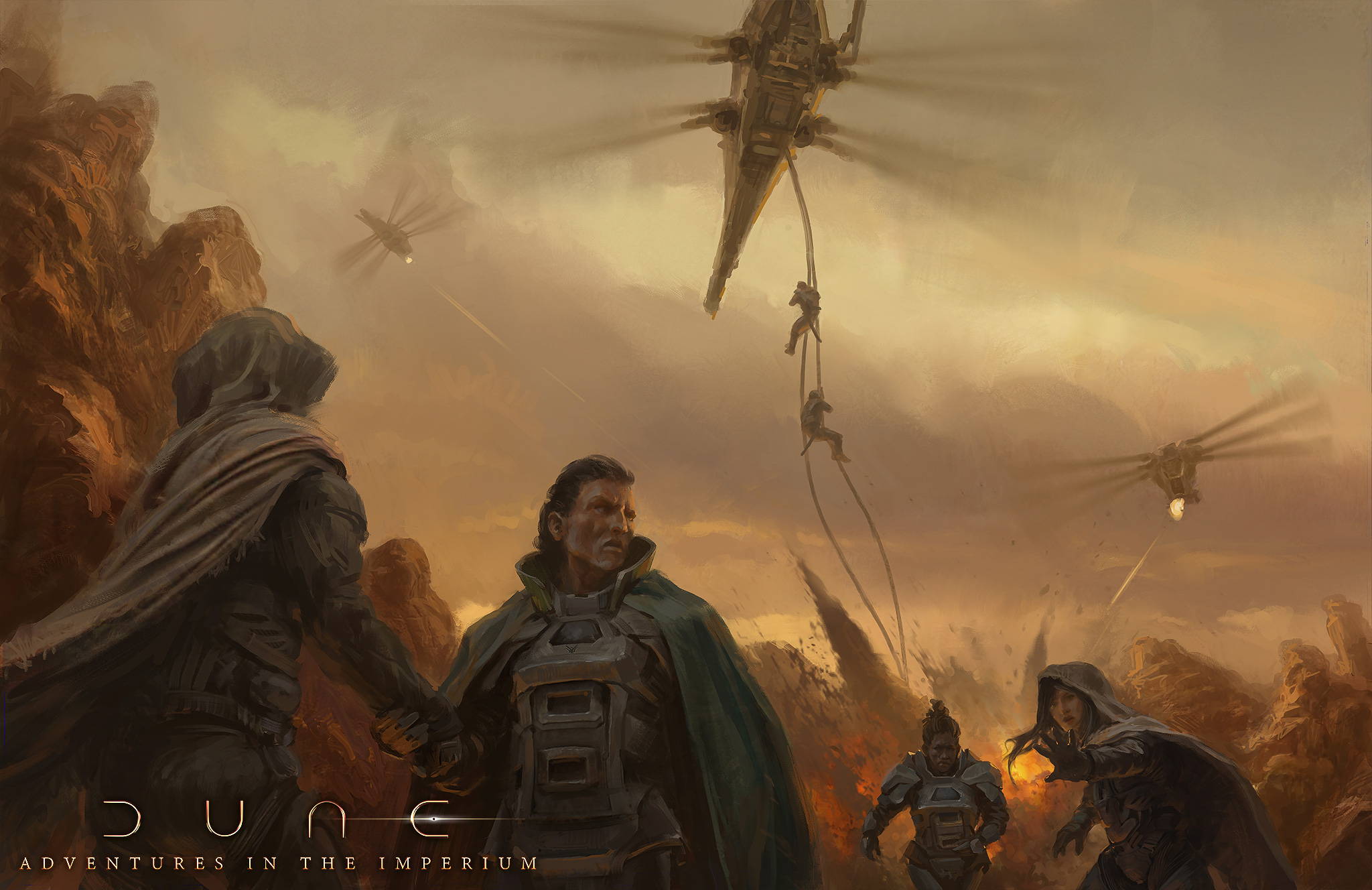 |
| Image by Modiphius Entertainment |
What I Would Borrow For Other RPGs
Even though parts of the system did not fully land for me mechanically, there are ideas here I would absolutely take into other games.
The biggest is the explicit connection between a character's motivations and the rules themselves through Drives.
I really liked the negotiation between player and GM around whether a character's beliefs genuinely supported an action. It reminded me a little of Blades in the Dark, where players and GM collaboratively establish how skills and approaches apply to the fiction.
Traditional RPGs often reduce this to:
"Roll this skill at this difficulty."
Dune RPG pushes the conversation further:
"Why does your character care enough to succeed here?"
That creates much stronger roleplaying moments.
I also found myself thinking about high-level D&D campaigns while playing. Characters above level 13 in D&D often become world-shaping figures, much closer to the scale of protagonists in Dune than traditional adventurers.
The different layers of conflict in Dune RPG — personal, political, military, social — made me think more seriously about how to handle large-scale consequences and factional play in high-level fantasy campaigns.
In summary
What stayed with me after this campaign was not whether we had mastered the rules.
It was the feeling of sitting around a table debating impossible political decisions while trying to hold a fragile House together under enormous pressure.
Dune RPG delivered that experience remarkably well.
I still think parts of the system are more complicated and abstract than they need to be, particularly for groups learning the game for the first time.
But I also think this campaign taught me something useful:
Sometimes understanding a game perfectly matters less than understanding what experience the group is trying to create together.
For us, that experience was intrigue, tension, ambition, compromise, and consequence.
And on those fronts, Dune RPG absolutely succeeded.
Dashmeister
:format(webp):no_upscale()/cdn.vox-cdn.com/uploads/chorus_asset/file/22960574/DUNE_CORE_5_05_Fortune_Teller.jpg) |
Image by Modiphius Entertainment
This blog is written by me, with a little help from AI editing for clarity and tone. All ideas, feelings, and memories are mine. |