Dragonbane: Old-School Danger, New-School Design - a D&D Player's View
- Get link
- X
- Other Apps
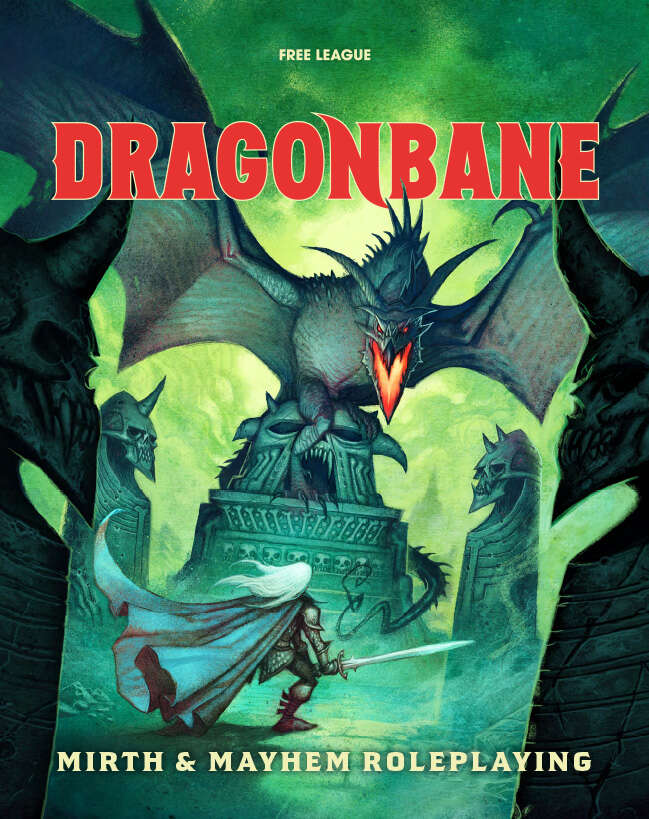 |
| Image by Free League |
[7 min read]
As part of my ongoing research into new tabletop RPGs, I’ve just finished a solo run of Dragonbane, using Alone in Deepfall Breach. Instead of packing the game away, I found myself wanting to stay. Not just to keep playing solo, but to extend the experience into party play. That’s usually a good sign.
What follows isn’t a review in the traditional sense. It’s a snapshot of how Dragonbane feels in motion, first as a system, then as a solo experience, as seen through the eyes of a long-time Dungeons & Dragons player.
Dragonbane as a System: Old Bones, New Muscles
At its core, Dragonbane is a roll-under d20 system. If that makes you think of early D&D, you’re not wrong, but it’s also not the full story. Dragonbane traces its lineage through Swedish roleplaying rather than directly through Dungeons & Dragons, even if the family resemblance is obvious.
Most of the time, resolution is simple. You roll under the relevant stat or skill. There’s very little maths, very few modifiers, and almost no friction. The only real twist comes from Boons and Banes, which are effectively advantage and disadvantage. Roll twice, take the best or worst. It’s familiar, elegant, and it works.
Critical results matter here. Roll a Dragon (1) and you get a critical success. Roll a Demon (20) and you critically fail. Both come with consequences, not just in combat but out in the world as well. It gives even mundane rolls a sense of gravity.
 |
| The Dragon and Demon d20 customisations are a nice touch Image by Free league |
Where Dragonbane really starts to show its personality is progression. There are no levels. Instead, advancement is tied to skills, and it’s slow, deliberate, and a little unpredictable. When you roll a Dragon or Demon while using a skill, you mark it. At the end of the session, you roll for each marked skill. If you roll above it, the skill increases by one.
It’s a subtle system, but it does something important. It keeps power growth modest and uneven. You don’t surge forward in tidy chunks. You inch ahead. When a skill finally reaches 18, you earn a heroic feat, but that’s a long road. The tone this sets is unmistakable: this is a dangerous world, and you are not destined to conquer it quickly.
That tone carries straight into combat.
Fights in Dragonbane are fast and often brutal. Player characters don’t have many hit points, while damage dice are large enough that a lucky strike can end things quickly. Initiative is handled with cards, which adds a pleasant layer of uncertainty, and the action economy forces real decisions.
If you want to parry or evade, that costs your action. You cannot attack and defend in the same breath unless you have a specific ability that allows it. This will be a shock to players coming from modern D&D, but I found it refreshing. Combat becomes about positioning, cooperation, and survival rather than individual optimisation.
Dragonbane treats monsters differently from players and NPCs. Monsters don’t roll to succeed - they always hit. The GM rolls to see how what type of attack they bring against the party. Your job is to respond, to defend, to survive. It’s a structure very similar to the Alien RPG’s xenomorph tables, and it works wonderfully to create the feeling that the monsters are rare, mythic and playing by different rules.
One of Dragonbane’s quiet strengths is its condition system. When you Push - Dragonbane's reroll mechanic - success or failure, you gain a condition tied to one of your abilities. These conditions affect future rolls and are easy to tie into the fiction. For example, if a character is affected by the Angry condition, they take a Bane on intelligence-based actions moving forward. It is simple, evocative, and invites role-play.
Recovery sits somewhere between old and new school. A short fifteen-minute stretch rest removes a condition, plus restores a small amount of Hit Points and Willpower. This feels generous until you realise how often you need it - and you can only do it once before you need rest over a full shift. Death saves exist, but the system is forgiving enough that survival feels possible without ever feeling safe.
Taken together, Dragonbane feels like a careful blend. Old-school danger, modern sensibilities. Low fantasy, but not without heroism. I genuinely think it would be easier to teach to a new group than D&D, especially one that doesn’t care about brand familiarity.
 |
| A different flavour of dragon for those not brand loyal Image by Free League |
Alone in Deepfall Breach: Solo, but Well-Supported
The solo supplement, Alone in Deepfall Breach, is a thin booklet tucked into the core set, and it’s far better than its size suggests.
 |
| The Dragonbane core set packs a lot of value in a beautiful box, including solo rules Image by Free League |
Mechanically, it includes everything you’d expect from a modern solo toolkit. Fortune tables handle yes-or-no questions with more nuance than a flat binary. Inspiration tables, reminiscent of The One Ring’s Strider Mode, combine actions and descriptors to spark ideas. I used these constantly, and they worked to keep the story flowing.
Combat is particularly well-supported for the solo player.
For more mundane enemies, like goblins or cultists, the solo rules provide action tables that randomly, but logically, decide what they do each round. That is a nice pairing with the monsters randomised attacks. While I don’t strictly need these as a GM, as a solo player they added unpredictability and reduced mental load. Combat felt chaotic and alive rather than pre-scripted.
Solo character creation is restrained. You gain one additional heroic feat, and that’s it. Two of these feats are clearly designed for solo play. One allows you to Push rolls without taking conditions. The other, Army of One, gives you two actions per round instead of one.
I took Army of One, and I can’t imagine playing solo without it. Action economy is everything when you’re alone. Without that second action, combat would be punishing to the point of frustration. Beyond that, though, your character remains fragile. You are not a superhero. You are simply slightly less doomed.
Narratively, Deepfall Breach is structured around a patron who sends you on missions. Each mission contains a set number of points of interest. Some are described up front, as if the patron has been there before. Others are unknown, revealed through tables when you arrive.
I loved this structure. It gives you momentum without dictating outcomes. You know how far you have to go, but not what you’ll find along the way. The journey between locations is abstracted, which keeps the focus on scenes rather than logistics.
Where the solo supplement is lighter is in procedural guidance. Unlike Alien, The One Ring, or The Walking Dead RPGs, it doesn’t walk you through solo play step by step. It assumes you already know how to inhabit a scene, ask questions, and move forward. For experienced solo players, that’s fine. For newcomers, it may feel like being handed excellent tools without a blueprint.
 |
| Meet my first Dragonbane character - Traut Skinflint Character sheet by Free League |
Staying With the Game
After finishing my first solo mission, I didn’t feel done. I felt curious. Curious enough to keep my solo character alive, and curious enough to bring in a small party to see how Dragonbane changes when cooperation becomes mandatory rather than optional.
That, more than anything, is why this article exists. Dragonbane didn’t just function at the table. It invited me to stay. In a hobby crowded with games that shout for attention, that quieter pull is worth noticing.
If you’re a D&D player looking for something lighter, faster, and a little deadlier without being needlessly punishing, Dragonbane is well worth your time. And if you’re a GM hoping to introduce new players to something recognisably D&D-shaped, but without the weight of decades of rules and expectations, Dragonbane might be exactly the game your table needs.
Dashmeister
 |
| Image by Free League |
This blog is written by me, with a little help from AI editing for clarity and tone. All ideas, feelings, and memories are mine.
- Get link
- X
- Other Apps


